How I Deliver

Building AI solutions through discovery, iteration, and disciplined product management

Iteration Over Perfection

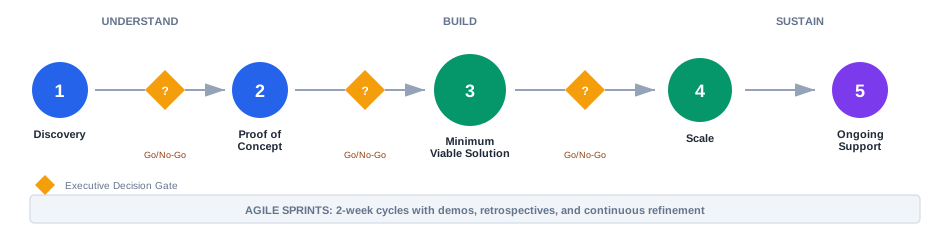
The perfect solution rarely emerges on day one. Teams often rush to build a "complete" solution only to discover fundamental misunderstandings late in the process. I lead teams through a structured product development lifecycle that treats iteration as a feature, not a bug: discovery, proof of concept, minimum viable solution, scale, and ongoing support.

This isn't about moving slowly. It's about moving deliberately. Investing time upfront to understand the problem avoids costly rework later.
The Product Development Lifecycle

Product Development Lifecycle

Orange diamonds represent executive go/no-go decision gates. Agile sprints run continuously throughout all phases.

Agile Product Delivery

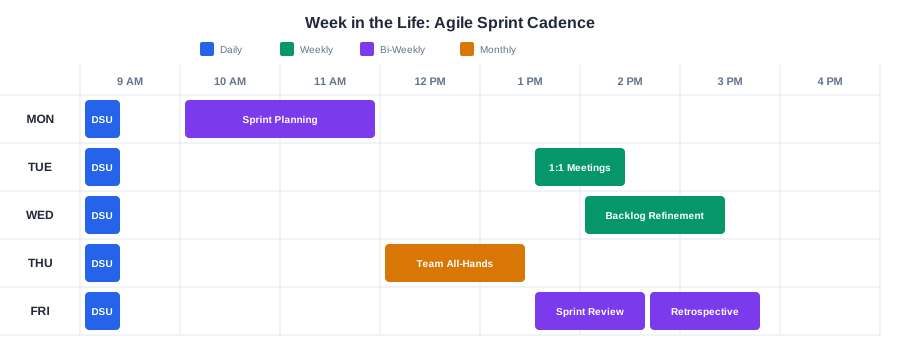
I use Agile practices throughout all phases. Teams operate in two-week sprints with defined roles and regular ceremonies.

Team Structure

Product Manager Owns the roadmap, prioritizes work, represents stakeholder interests
Business Analyst Manages backlog, refines requirements, bridges business and technical
Sprint Cadence Two-week sprints with demos, retrospectives, and continuous refinement
Stakeholder Engagement Regular demos keep everyone aligned and surface issues early
Week in the Life: Agile Sprint Cadence
1

Discovery

Understand the problem before committing to a solution. This phase covers stakeholder interviews, data exploration, constraint mapping, and hypothesis formation.

Key Activities

  • Stakeholder Interviews - Objectives from sponsors, technical leads, and end users
  • Data Exploration - Available sources, quality assessment, gaps
  • Constraint Mapping - Technical limitations, compliance, organizational factors
  • Hypothesis Formation - Initial theory of what the solution should do

Deliverables

Problem Statement
Success Criteria
Data Assessment
2

Proof of Concept

Test the hypothesis before building production infrastructure. The PoC answers critical questions: Can we access the data? Does the approach yield results? What assumptions were wrong?

Key Activities

  • Rapid Prototyping - Focused prototype testing the core hypothesis
  • Technical Validation - Data access, model feasibility, integration patterns
  • Stakeholder Demos - Early results, feedback, direction validation
  • Learning Documentation - What worked, what didn't, revised understanding

Deliverables

Working Prototype
Validation Findings
Refined Requirements
3

Minimum Viable Solution

Design the production solution based on PoC learnings. Build the right things, not everything. Architecture decisions are informed by real data, not assumptions.

Key Activities

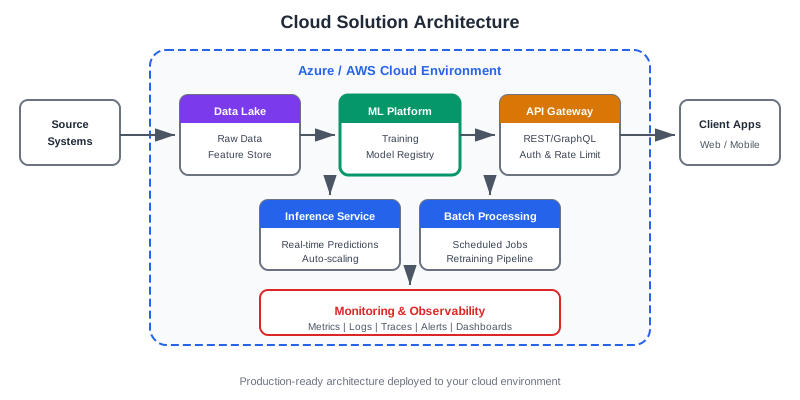
  • Architecture Design - Cloud resources, security boundaries, integration patterns
  • Scope Definition - What's in the MVS vs. deferred to future iterations
  • Technical Specifications - APIs, data flows, infrastructure requirements
  • Backlog Creation - Prioritized, actionable work items
Solution Architecture

Deliverables

Architecture Design
MVS Scope Document
Prioritized Backlog
4

Scale

Deploy to the business and drive adoption. Train users, manage change, and expand across the organization. The goal is measurable business impact, not just a system that runs.

Key Activities

  • Production Deployment - Live business environments with monitoring and alerting
  • User Training - End users, power users, technical operators
  • Change Management - Drive adoption, address resistance
  • Phased Rollout - Pilot groups, feedback, systematic expansion
  • Documentation - User guides, runbooks, technical docs

Training Tracks

Business Users System overview, interpreting outputs, feedback mechanisms
Technical Ops Infrastructure management, deployment procedures, incident response
Data Science Model retraining, feature engineering, drift detection
Leadership KPI dashboards, ROI tracking, expansion roadmap

Deliverables

Live Production System
Trained User Base
Documentation Package
5

Ongoing Support

Launching is just the beginning. Real-world usage always reveals opportunities for improvement. I provide post-launch support to ensure smooth operations, and we continue iterating on the backlog based on production feedback. The solution evolves with your needs.

Responsive Support

Quick response for critical issues, regular check-ins for ongoing questions

Bug Fixes

Resolution of any defects discovered in production

Backlog Evolution

Continuous refinement based on real-world usage and feedback

Continuous Improvement

Iterative enhancements driven by production insights

Let's Talk About Your Challenge

Every initiative is different. Let's discuss your unique situation and figure out the right approach together.