
I've interviewed many candidates for principal data scientist positions over the years. What used to be occasional gaps in understanding have become much more the norm. I noticed this year in particular, quite a large decline in candidates who don't really understand what this role requires. I could write an entire article on why I think this happening. However, lets focus on what being a principal means.
Candidates can talk about XGBoost. They can explain gradient descent at a rudimentary level. They can recite the bias-variance tradeoff and law of large numbers. But when I ask them to walk me through how they'd present a model's business case to an executive, or how they'd structure a Python codebase for a production ML system, the conversation stalls.
The principal data scientist role isn't just "senior data scientist plus a few more years." It represents a fundamental shift in how you operate. And the industry has done a poor job of explaining what that shift looks like in practice.
This article is my attempt to address this issue. Whether you're a junior data scientist mapping your career, a senior professional eyeing the next level, or a hiring manager trying to define what "principal" means at your organization—from my own experience, I want to give you a concrete picture of what good looks like.
The Core Shift: From Problem Solver to Problem Definer
Before diving into specific skills, let's establish the fundamental difference between senior and principal levels.
A senior data scientist receives a problem and solves it. "We need a churn model for our subscription product." They scope the data, build the model, validate it, and hand it off.
A principal data scientist identifies which problems are worth solving in the first place. They see that churn is a manifestation of something deeper, not the cause. They recognize that the real opportunity might be in predicting which customers will expand their usage. They connect dots across the organization that others don't see.
This isn't just about experience. It's about operating at a different altitude. Principals think in systems, not projects. They ask "what should we be building?" before "how do we build it?"
With that framing in mind, let's examine the specific capabilities that separate principals from seniors.
Skill 1: Creating Compelling Presentations for Business Stakeholders
This is where I see the most consistent gap in principal candidates. They can build models all day, but they cannot communicate their value to the people who fund them.
What Bad Looks Like
I've reviewed many slide decks from data scientists. I tend to see two patterns.
First is simply the complete inability to create much of a slide at all. No theming, storytelling, or business points—just simple tables and metrics that must be explained during a presentation. The slides don't stand on their own.
The second pattern I see are 20 slides of methodology, feature importance charts, confusion matrices, and ROC curves. Somewhere around slide 17, there's a recommendation buried in technical jargon.
Executives don't read these decks. They flip to the end, find nothing actionable, and move on. The data scientist wonders why their project never got prioritized.
What Good Looks Like
A principal-level presentation is three to four slides, maybe five. It tells a story with a clear arc.
The best framework I've found for this is the SCQA structure, developed by Barbara Minto at McKinsey. SCQA stands for Situation, Complication, Question, and Answer. It's the backbone of how top consulting firms communicate complex recommendations to executives. The core insight is simple: executives prefer knowing your conclusion immediately, not after 30 slides of buildup.
Here's how I've adapted SCQA into a practical slide structure for data science presentations:
| SCQA Element | Slide | What It Contains |
|---|---|---|
| Situation + Complication | Slide 1: The Business Problem | Current state and what's going wrong. Quantified impact. |
| Answer | Slide 2: The Proposed Solution | Your recommendation at a conceptual level. How it fits into existing workflows. |
| Supporting Arguments | Slide 3: Expected Impact & Requirements | Projected outcomes, what you need, timeline. |
| Implementation | Slide 4: The Path Forward | Next 90 days, milestones, risks, decisions needed. |
Let me walk through each slide in detail.
Slide 1: The Business Problem (Situation + Complication). State the problem in business terms, not technical terms. Quantify the impact. "We're losing $2.4M annually to customer churn, concentrated in our enterprise segment during months 4-6 of their contract." No mention of models, algorithms, or data. Just the problem and why it matters. The situation is the context; the complication is why this demands attention now.
Slide 2: The Proposed Solution (Answer). This is where SCQA differs from how most data scientists present. You give your answer early, not at the end. Explain your approach at a conceptual level. "We've developed an early warning system that identifies at-risk accounts 60 days before typical churn indicators appear, giving our success team a meaningful intervention window." Include a simple diagram showing how the solution fits into existing workflows. Avoid technical architecture. Focus on the human process.
Slide 3: Expected Impact and Requirements (Supporting Arguments). Now you support your answer with evidence and specifics. Quantify the expected outcome. "Based on pilot results, we project a 23% reduction in enterprise churn, representing $550K in preserved annual revenue." State what you need: data access, engineering support, stakeholder time for validation. Be specific about timelines. This slide answers the unspoken question: "Why should I believe this, and what does it cost me?"
Slide 4 (if needed): The Path Forward (Implementation). Outline the next 90 days. What are the milestones? What decisions need to be made? What are the risks and how will you mitigate them? This slide turns your recommendation into action.
That's it. Four slides. A CFO can read this in three minutes and make a decision. The technical details live in an appendix they'll never open unless they have questions.
The Underlying Skill
This isn't about dumbing things down. It's about translation. You're taking complex technical work and expressing it in the language your audience speaks: dollars, risk, timelines, and competitive advantage.
Principals can do this translation fluidly because they genuinely understand the business context. They've spent time learning how their company makes money, what keeps executives up at night, and what success metrics actually matter.
If you want to develop this skill, stop reading machine learning papers for a month. Read your company's investor presentations instead. Listen to earnings calls. Understand the P&L. Then rebuild your presentations from scratch with that context in mind.
Skill 2: Writing Clean, Maintainable, Production-Quality Code
Here's an uncomfortable truth: most data scientists write code that only they can understand, and only for about two weeks after they wrote it.
Notebooks are the default environment. Functions are rare. Tests are nonexistent. Documentation doesn't exist. When the data scientist leaves the company, their models become archaeological artifacts that nobody can maintain.
Principals write code that lives beyond them.
What Bad Looks Like
A Jupyter notebook with 50 cells. Global variables scattered throughout. Copy-pasted code blocks with minor variations. Hardcoded file paths. No functions, just a linear script that must be run top to bottom. Comments like # this works, don't touch or # TODO: fix this later.
This code might produce correct results today. But it cannot be tested, cannot be reviewed, cannot be deployed, and cannot be maintained by anyone else.
What Good Looks Like
Principal-level code is modular, object-oriented, and structured for collaboration. Here's what that means in practice.
churn_prediction/
├── README.md
├── pyproject.toml
├── requirements.txt
├── build.sh
├── .gitignore
├── dist/
│   └── churn_prediction-0.1.0-py3-none-any.whl
├── src/
│   └── churn_prediction/
│       ├── __init__.py
│       ├── config/
│       │   ├── __init__.py
│       │   └── settings.py
│       ├── data/
│       │   ├── __init__.py
│       │   ├── loaders.py
│       │   └── validators.py
│       ├── features/
│       │   ├── __init__.py
│       │   ├── engineering.py
│       │   └── transformers.py
│       ├── models/
│       │   ├── __init__.py
│       │   ├── training.py
│       │   ├── evaluation.py
│       │   └── prediction.py
│       └── utils/
│           ├── __init__.py
│           ├── logging.py
│           └── metrics.py
├── data/
│   ├── 01_raw/
│   ├── 02_staging/
│   ├── 03_curated/
│   └── notebooks/
│       ├── 01_ingest_raw_data.py
│       ├── 02_clean_and_validate.py
│       ├── 03_feature_engineering.py
│       └── 04_prepare_training_set.py
├── apps/
│   ├── model/
│   │   ├── __init__.py
│   │   ├── inference.py
│   │   ├── trainer.py
│   │   └── config.yaml
│   ├── api/
│   │   ├── __init__.py
│   │   ├── serve.py
│   │   └── schemas.py
│   └── dashboards/
│       └── churn_monitoring.py
├── tests/
│   ├── __init__.py
│   ├── test_loaders.py
│   ├── test_transformers.py
│   └── test_models.py
└── configs/
    ├── model_config.yaml
    ├── feature_config.yaml
    └── logging_config.yaml
Understand what each directory does. This structure isn't arbitrary—each folder has a specific purpose:
src/— This is your installable library. It's what gets packaged and pip-installed. All your reusable logic lives here: data loaders, feature transformers, model classes, utilities. This code should be environment-agnostic and import-ready.apps/— This is where you actually use the library. Your inference scripts, API endpoints, training jobs, and dashboards live here. These are the entry points that import fromsrc/and wire everything together for specific use cases.tests/— This is where you validate that your library works correctly. Unit tests for individual functions, integration tests for pipelines, and regression tests to catch breaking changes. Tests run againstsrc/, notapps/.data/— Staged data directories and exploratory notebooks. Raw data comes in, gets cleaned, and flows through to curated outputs. Notebooks here are for exploration only—once something works, it gets refactored intosrc/.configs/— All parameters that might change: model hyperparameters, feature lists, environment settings. Never hardcode values that could vary across experiments or deployments.
Why this structure matters:
- Separation of concerns — Library code (
src/) is decoupled from application code (apps/). You can change how you serve predictions without touching your feature engineering logic. - Reusability — The same
src/package can power a batch job, a real-time API, and a dashboard. Write once, use everywhere. - Testability — When logic is isolated in
src/, you can unit test it without spinning up infrastructure. Tests are fast and focused. - Clear ownership — New team members know exactly where to look. Data loading issues? Check
src/data/. API bugs? Checkapps/api/. - Deployability — You can pip-install your package into any environment. No copy-pasting notebooks or hunting for dependencies.
What happens when code isn't organized:
- Nothing is reusable. Logic is scattered across notebooks, duplicated with slight variations. Fixing a bug means finding every copy.
- Testing is impossible. You can't unit test a notebook cell that depends on 47 previous cells and global variables.
- Deployment is manual. Someone has to "click through the cells in order" and hope nothing breaks. This doesn't scale.
- Onboarding takes forever. New team members spend weeks deciphering tribal knowledge instead of contributing.
- Knowledge walks out the door. When the original author leaves, their notebooks become archaeological artifacts. The model dies with them.
Write classes with clear responsibilities. Instead of scattered functions, create classes that encapsulate behavior. A FeatureEngineer class with fit() and transform() methods. A ModelTrainer class that handles the training loop. This code is readable, testable, and reusable.
Write tests. At minimum, test your data transformations and model predictions. Tests catch bugs before they reach production. They also serve as documentation for how your code is supposed to behave.
The Underlying Skill
Writing production code requires you to think about the next person who will touch this code. That might be a junior data scientist trying to understand your approach. It might be an ML engineer deploying your model. It might be you, six months from now, trying to figure out why something broke.
Principals write code with empathy for future readers (and themselves).
Skill 3: Designing and Building ML Models From First Principles
The dirty secret of applied data science is that most practitioners have a very shallow toolkit. They reach for XGBoost or random forests for every tabular problem, fine-tune a pre-trained transformer for every NLP task, and call it a day.
This works until it doesn't. And when it doesn't, they're stuck.
What Bad Looks Like
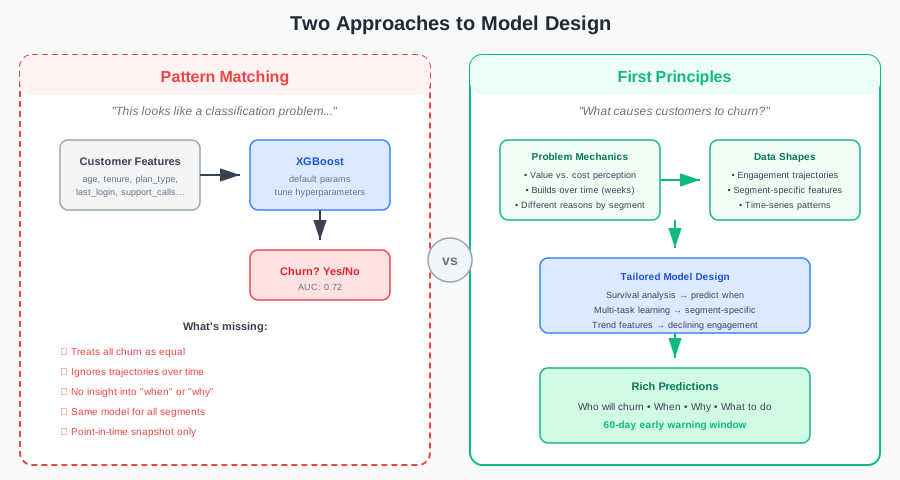
"I tried XGBoost with default parameters, then I tuned the hyperparameters, then I tried LightGBM, and the AUC is still only 0.72. I don't know what else to do."
The candidate has no mental model for why their approaches aren't working. They're pattern-matching from tutorials, not reasoning from first principles.
What Good Looks Like
A principal data scientist approaches model design like an engineer approaches system design. They start with the problem characteristics and work backward to the solution.
What "First Principles" Means
First principles thinking means breaking a problem down to its fundamental truths and reasoning up from there, rather than reasoning by analogy or pattern-matching from what's worked before.
Most people reason by analogy: "This problem looks like that problem, so I'll use the same solution." First principles thinking asks instead: "What do I know to be true about this problem? What are the underlying mechanics? What solution does that suggest?"
Example: Predicting Customer Churn
Without First Principles (Pattern Matching)
"I need to predict churn. Churn is a binary classification problem. I'll grab all the customer features I have, throw them into XGBoost, tune the hyperparameters, and see what AUC I get. If it's not good enough, I'll try LightGBM. Maybe add some more features."
This approach treats the problem as a generic classification task. The data scientist is copying a pattern they've seen work elsewhere without thinking deeply about this specific problem.
With First Principles
"What actually causes a customer to churn? Let me think about the mechanics."
- Churn happens when perceived value drops below perceived cost
- Value perception changes over time based on usage patterns and outcomes
- The decision to leave isn't instantaneous; it builds over weeks or months
- Different customer segments churn for different reasons (price sensitivity vs. feature gaps vs. poor support experiences)
"What does this tell me about how to model the problem?"
- A single point-in-time snapshot might miss the trajectory. I should look at trends in engagement, not just current values.
- A binary classifier treats all churn as equal, but the causal pathways differ. Maybe I need separate models for different segments, or a multi-task approach.
- The timing matters. A survival model might capture the "when" better than a classifier that only predicts "if."
- Feature engineering should focus on change patterns: declining usage, increasing support tickets, lengthening time between logins.
The first principles approach doesn't start with "what algorithm should I use?" It starts with "how does this phenomenon actually work?" The model design follows from that understanding.
The Underlying Skill
This requires genuine understanding of statistical learning theory, not just familiarity with APIs. You need to know why regularization works, what the bias-variance tradeoff actually means geometrically, how gradient descent navigates loss surfaces, and what assumptions your models make.
If you want to develop this, go back to fundamentals. Work through Elements of Statistical Learning. Implement algorithms from scratch. Derive gradients by hand. Build intuition that goes deeper than code snippets.
Skill 4: Deploying Models Through CI/CD Pipelines With Containerization
A model that lives in a notebook has zero business value. Value comes from models that run in production, serving predictions reliably, at scale, without manual intervention.
Many data scientists treat deployment as someone else's problem. "I built the model, engineering can figure out how to deploy it." This handoff mentality is why so many ML projects die in pilot purgatory.
Principals own the full lifecycle.
What Bad Looks Like
"The model is in this notebook. You can run it by clicking through the cells in order. The data needs to be in this specific folder. Oh, and you need to install these packages, but I don't remember which versions. Let me know if you have questions."
This is not a deployment. This is a future disaster.
What Good Looks Like
Containerize everything. Your model should run identically on your laptop, on a colleague's machine, and in production. Docker makes this possible. With a Dockerfile, anyone can run your model with a single command. No dependency hell, no "works on my machine" problems.
Here's a real example—a Dockerfile that packages our churn prediction model as an Azure Function:
# Base image with Azure Functions runtime
FROM mcr.microsoft.com/azure-functions/python:4-python3.10

# Install Miniconda
ENV CONDA_DIR=/opt/conda
RUN wget -q https://repo.anaconda.com/miniconda/Miniconda3-latest-Linux-x86_64.sh -O /tmp/miniconda.sh && \
    bash /tmp/miniconda.sh -b -p $CONDA_DIR && \
    rm /tmp/miniconda.sh
ENV PATH=$CONDA_DIR/bin:$PATH

# Set working directory
WORKDIR /home/site/wwwroot

# Copy and install dependencies first (layer caching)
COPY requirements.txt .
RUN conda install -y pip && \
    pip install --no-cache-dir -r requirements.txt

# Copy the installable package and install it
COPY dist/churn_prediction-0.1.0-py3-none-any.whl .
RUN pip install churn_prediction-0.1.0-py3-none-any.whl

# Copy model artifacts
COPY apps/model/config.yaml ./model/config.yaml
COPY models/ ./models/

# Copy Azure Function configuration and inference endpoint
COPY apps/api/serve.py .
COPY apps/api/schemas.py .
COPY host.json .
COPY function_app.py .

# Azure Functions will look for this
ENV AzureWebJobsScriptRoot=/home/site/wwwroot
ENV AzureFunctionsJobHost__Logging__Console__IsEnabled=true

# Health check
HEALTHCHECK --interval=30s --timeout=10s --start-period=5s --retries=3 \
    CMD curl -f http://localhost:80/api/health || exit 1
This Dockerfile tells a clear story: start with Azure's Python runtime, install Conda for environment management, install dependencies, copy our model package and artifacts, then configure the function endpoint. Anyone on the team can build this image and get identical results.
Automate with CI/CD. Every push to your repository should trigger automated checks. Tests run automatically. Images build automatically. Deployments happen automatically when tests pass. No manual steps means no human error.
Version everything. Code is versioned in git. Data is versioned in Databricks Unity Catalog. Models are versioned in a model registry like MLflow. Configs are versioned alongside code. When something goes wrong in production, you need to know exactly what code, data, and model artifact was running.
Monitor in production. Deployment isn't the end; it's the beginning. Models degrade over time as the world changes. You need monitoring for input data distributions, prediction distributions, model performance, population mix, and system health. When metrics drift, alerts fire, and you investigate before customers notice.
The Underlying Skill
This requires thinking like a software engineer, not just a data scientist. You need to care about reliability, reproducibility, and operational excellence.
If this is unfamiliar territory, start small. Dockerize your next project. Set up a simple CI pipeline. Deploy a model to a cloud endpoint. Each project is an opportunity to level up your MLOps capabilities.
Skill 5: Mentoring Junior Data Scientists
The final capability that defines principals is their ability to multiply their impact through others. A principal who hoards knowledge and works in isolation is failing the role.
What Bad Looks Like
"I don't have time to review code; I'm too busy with my own projects."
"Just look at my old notebooks if you want to learn how to do it."
"Why are you bothering me with this question? Figure it out yourself."
This creates a team of isolated individuals who repeat each other's mistakes and never grow.
What Good Looks Like
Conduct thorough code reviews. When a junior data scientist opens a pull request, take it seriously. Don't just approve and move on. Read the code carefully. Ask questions. Suggest improvements. Explain why something should be different. A good code review comment doesn't just say "change this." It explains the reasoning. Code reviews are teaching opportunities. Use them.
Check work before it goes to stakeholders. Junior data scientists will make mistakes in analysis. They'll misinterpret data, draw incorrect conclusions, or present findings poorly. These mistakes shouldn't reach business stakeholders. Principals review deliverables before they leave the team. Not to micromanage, but to catch errors and coach improvement.
Set visible standards. Your code, your presentations, your communication all serve as templates for the team. If you write sloppy code, you're implicitly telling juniors that sloppy code is acceptable. Be deliberate about what you produce. It will be imitated.
Create learning opportunities. Invite junior team members to stakeholder meetings so they see how senior people communicate. Pair program on complex problems. Share interesting papers and discuss them. Build a culture of continuous learning.
Give honest feedback, kindly. Growth requires feedback, and feedback requires candor. Don't sugarcoat problems. If someone's presentation skills are weak, tell them directly and offer specific guidance for improvement. Kindness doesn't mean avoiding hard truths; it means delivering them with respect and a genuine desire to help.
The Underlying Skill
Mentorship requires patience, communication skills, and a genuine investment in others' growth. It also requires letting go of ego. Your job is not to be the smartest person in the room! It's to make the room smarter.
The Path Forward
If you're a junior or mid-level data scientist reading this, you might feel overwhelmed. These skills take years to develop. Nobody expects you to master them overnight.
But you can start now. Build these skills slowly into your current work, even if no one asks for it. Spending time to learn without the pressure is where you will gain the skills you need for the high-pressure delivery schedules later.
Pick one area where you're weakest. Maybe it's presentations. Maybe it's production code. Maybe it's model design. Focus on that area deliberately. Read, practice, seek feedback, iterate.
Find principals at your company or in your network. Watch how they operate. Ask them for mentorship. Most will be happy to help if you approach them with genuine curiosity and a willingness to learn.
If you're already a principal, remember that juniors are watching how you operate. Your code reviews, your stakeholder interactions, your approach to ambiguity, these become the template they model. Make time for mentorship
What skills do you think are most important for principal data scientists? What areas do you find most challenging to develop? I'd love to hear your perspective in the comments.